
Where Does United States (Western Medicine) Rank In Life Expectancy?
Until the early 1990s, despite the accomplishments of certain high-income countries in achieving significant continued improvements in life expectancy at birth, there was considerable disagreement among gerontologists and demographers as to what the future might bring. On the one hand, pessimists believed that the deaths above age 80 were due to problems associated with senescence and intractable aging processes. Consequently, increases in longevity beyond age 85 or so were unlikely to be achievable without fundamental biomedical breakthroughs that would affect those processes themselves. On the other hand, optimists believed that continued improvements in life expectancy were to be expected and that the official population projections of the time were too conservative.
A lack of reliable and internationally comparable data initially limited demographers’ ability to study patterns of mortality and morbidity at advanced ages. In the United States, for example, demographers have long been wary of using mortality data at older generations because of concerns about the quality of the data and the validity of age reporting.
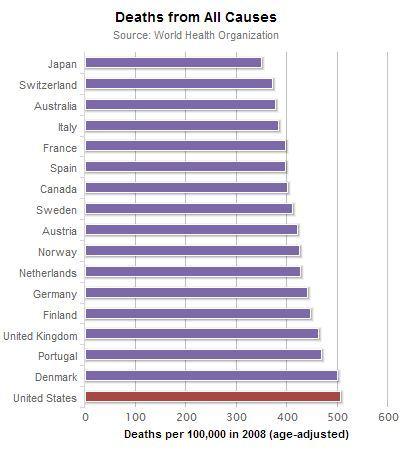
We’ve known for years that Americans tend to be overweight and sedentary and that our health care system, despite being the most expensive in the world, produces some less-than-plum results. Health nerds who closely follow the news may even have known that we live shorter lives than people in other wealthy nations and that infants in the U.S. die from various causes at far higher rates.
The report was prepared by a panel of doctors, epidemiologists, demographers, and other researchers charged by the National Research Council and the Institute of Medicine to better understand Americans’ comparative health. They examined when and why people die in the U.S. and 16 other countries, including Australia, Japan, Canada, and nations in Western Europe. The data they pulled — from such bodies as the World Health Organization and the Organization for Economic Cooperation and Development — already existed, but no one had yet examined it this comprehensively.
The results surprised even the researchers. To their alarm, they said, they found a “strikingly consistent and pervasive” pattern of poorer health at all stages of life, from infancy to childhood to adolescence to young adulthood to middle and old age. Compared to people in other developed nations, Americans die far more often from injuries and homicides. We suffer more deaths from alcohol and other drugs and endure some of the worst rates of heart disease, lung disease, obesity, and diabetes.
These disproportionate deaths, primarily affect young people. For three decades, Americans, particularly men, have had either the lowest or near the lowest likelihood of surviving to age 50. The most powerful reasons found for that were a homicide, car accidents, other kinds of accidents, non-communicable diseases, and perinatal problems like low birth weight and premature birth, which contribute to high infant mortality.
Among the most striking of the report’s findings are that among the countries studied, the U.S. has:
- The highest rate of death by violence, by a stunning margin
- The highest rate of death by car accident, also dramatically so
- The highest chance that a child will die before age 5
- The second-highest rate of death by coronary heart disease
- The second-highest rate of death by lung disease
- The highest teen pregnancy rate
- The highest rate of women dying due to complications of pregnancy and childbirth
The report does reveal bright spots: Americans are more likely to survive cancer or stroke, and if we live to age 75 we’re likely to keep on living longer than others. But these advances are dwarfed by the grave shortcomings.
Where Does U.S. Rank In Crisis Care Intervention?
The World Health Report 2000, Health Systems: Improving Performance, ranked the U.S. health care system 37th in the world— a result that has frequently been discussed during the current debate on U.S. health care reform.
Despite having the most expensive health care system, the United States ranks last overall among 11 industrialized countries on measures of health system quality, efficiency, access to care, equity, and healthy lives, according to a new Commonwealth Fund report. The other countries included in the study were Australia, Canada, France, Germany, the Netherlands, New Zealand, Norway, Sweden Switzerland, and the United Kingdom. While there is room for improvement in every country, the U.S. stands out for having the highest costs and lowest performance—the U.S. spent $8,508 per person on health care in 2011, compared with $3,406 in the United Kingdom, which ranked first overall.
Despite the claim by many in the U.S. health policy community that international comparison is not useful because of the uniqueness of the United States, the rankings have figured prominently in many areas. It is hard to ignore that in 2006, the United States was number 1 in terms of health care spending per capita but ranked 39th for infant mortality, 43rd for adult female mortality, 42nd for adult male mortality, and 36th for life expectancy. These facts have fueled a question now being discussed in academic circles, as well as by government and the public: Why do we spend so much to get so little?
The current proposals for U.S. health care reform focus mostly on extending insurance coverage, decreasing the growth of costs through improved efficiency, and expanding prevention and wellness programs. The policy debate has been overwhelmingly centered on the first two of these elements. Achieving universal insurance coverage in the United States would protect households against undue financial burdens at the same time that it was saving an estimated 18,000 to 44,000 lives. However, narrowing the gap in health outcomes between the United States and other high-income countries or even slowing its descent in the rankings would require much more than insurance expansion.
Why Does Western Medicine Insist On Using Crisis Care Tactics For Prevention Situations?
Now that health care reform has been put on the back burner, maybe it is time to discuss what health care reform should look like. Although we talk about a “health care” system and health care reform, what we’re actually talking about is a “disease care” system and disease care reform. Doctors of modern western medicine are trained to treat disease with drugs and surgery. They are not trained to keep people healthy.
At medical school, the doctors are taught how to treat the symptoms of the disease, rather than how to prevent disease in the first place. For example, throughout the training, they receive very few lectures on nutrition, despite the fact that diet is fundamental to good health. Nor are they trained in other lifestyle modalities that help keep people well, such as exercise and relaxation therapies. They are taught nothing about the wisdom of alternative medical systems that have been helping other cultures for centuries.
I will be the first to acknowledge that modern western medicine and science have made phenomenal advances. These improvements alleviate pain and suffering and save lives every day. Better treatment of trauma and burns for example, or the management of acute medical and surgical emergencies, are among the miracles of modern life. We have drugs today that, when used appropriately, work wonders. We are indeed blessed to have modern western medicine in our arsenal, and for disasters like the Haiti earthquake, this kind of medicine is life-saving.
In a true health care system, we must use modern western medicine for what it is good at – crisis care, acute medical and surgical emergencies – and natural, non-toxic and non-invasive therapies whenever possible. The most effective ways of preventing and treating most chronic diseases are diet, supplements, exercise, stress management and other benign modalities. And herein lies the rub. Although guidance may be helpful, lifestyle changes can’t be imposed from above – they have to come from you. There is no greater reward than being the master of your health.
What Is The Origin Of Big Pharma? (When Did They Take Over)?
The term Big Pharma is used to refer collectively to the global pharmaceutical industry. According to Steve Novella, the term has come to connote a demonized form of the pharmaceutical industry. Professor of writing Robert Blaskiewicz has written that conspiracy theorists use the term Big Pharma as “shorthand for an abstract entity comprising corporations, regulators, NGOs, politicians, and often physicians, all with a finger in the trillion-dollar prescription pharmaceutical pie.”
The Big Pharma conspiracy theory has four classic traits: first, the assumption that a small malevolent cadre perpetrates the conspiracy. Secondly, believe that the public at large is ignorant of the truth; thirdly, that its believers treat lack of evidence as evidence; and finally, that the arguments deployed in support of the theory are irrational, misconceived or otherwise mistaken.
Big Pharma is the pejorative nickname given to the pharmaceutical industry. Critics of the industry often use this nickname when discussing abuses by the industry, including:
- Trying to suck every penny out of the pockets of the sick, injured, dying, and hypochondriacs; Inventing new maladies so people will buy more drugs (as opposed to inventing better drugs so more people would become addicts);
- Censoring alternative treatments that would be cheaper or more effective, rather than patenting and industrializing them (much as proponents of free energy claim censorship by energy companies, without basis);
- Renaming old maladies, so people will think their conditions are more serious, making them more willing to pay higher prices for prescriptions.
There are scientifically-literate criticisms of Big Pharma. However, the overwhelming majority of criticism comes from non-scientific bases. Many alternative medicine merchants (such as homeopaths and naturopaths) stridently blame most or all opposition on Big Pharma, rather than, say, a lack of scientific evidence for their claims.
When Did Insurance Companies Come About?
The history of insurance consisted of the development of the modern business of insurance against risks, especially regarding cargo, property, death, automobile accidents, and medical treatment. The industry helps to eliminate risks (as when fire insurance companies demand the implementation of safe practices and the installation of hydrants), spreads risks from the individual to the broader community, and provides an important source of long-term finance for both the public and private sectors. The insurance industry is profitable and provides attractive employment opportunities for white-collar workers.
In the United States, health insurance is any program that helps pay for medical expenses, whether through privately purchased insurance, social insurance or a social welfare program funded by the government. Synonyms for this usage include “health coverage,” “health care coverage” and “health benefits.” In a more technical sense, the term is used to describe any form of insurance that protects against the costs of medical services. This usage includes private insurance and social insurance programs, such as Medicare, which pools resources and spreads the financial risk associated with major medical expenses across the entire population to protect everyone, as well as social welfare programs such as Medicaid and the Children’s Health Insurance Program. Which assist people who cannot afford health coverage.
In addition to medical expense insurance, “health insurance” may also refer to insurance covering disability or long-term nursing or custodial care needs. Different health insurance provides different levels of financial protection, and the scope of coverage can vary widely, with more than 40 percent of insured individuals reporting that their plans do not adequately meet their needs as of 2007.
The share of Americans without health insurance has been cut in half since 2013. Many of the reforms instituted by the Affordable Care Act of 2010 were designed to extend health care coverage to those without it; however, high-cost growth continues unabated. National health expenditures are projected to grow 4.7% per person per year from 2016–2025. Public healthcare spending was 29% of federal mandated spending in 1990, 35% in 2000, and is projected to be roughly half in 2025.
Today, the internet has changed the insurance industry by blowing the field wide open. Now people can go online to find the cheapest rate, even as companies shop internationally for the right coverage. This is one source of motivation for companies to merge with other financial services. The increase in size gives them a global market and the integration of services gives them a domestic advantage with customers who are more concerned with convenience than price.
When Did Medical Doctors Go From Private Practices And Into Hospital Groups?
There is a dangerous trend underway in American healthcare: The death of the private practice doctor’s office. This is a deliberate trend driven primarily by federal policymakers, and it does not bode well for either the cost of healthcare or the health of individual patients.
Hospitals justified their mergers by claiming they helped reach economies of scale. But the mergers also reduced competition, helping the hospital systems negotiate higher reimbursements from health insurers.Then came the A.C.A., which envisioned large, integrated provider networks, and the government was willing to hand out billions of dollars to providers that successfully implemented the government’s vision of quality care.The effects on physicians and patients are unclear. But in a government-run health care chess game, both are just pawns.
The small, independent medical practices have long dominated the medical landscape. But increasingly, doctors are giving up their independence to join larger groups or hospital systems, often getting help with back-office functions like billing and insurance negotiations while staying in their old offices and seeing the same patients.
The idea is that by teaming up, doctors and hospitals can avoid repeat tests and offer the best possible care at the lowest price. It’s a notion that has long been percolating in the healthcare field. They’re sensing that change is necessary, and they want and desire and need perhaps a partnership with a health system. So our timetable to get there into accountable care and truly clinically integrated system have sped up.
Choosing between private practice and working at a hospital may be a weighty decision for doctors, but patients may not notice much of a difference.
When Did The Sub Specialization Of Medicine Begin? And When Did It Become So Compartmentalized?
The recent decline in the production of primary care physicians has been associated with a decrease in the production of general internists and an increase in the number of medical subspecialists. A significant majority of entering internal medicine residents anticipate entering a medical subspecialty. This transition in the development of the medical workforce, perceived by some as inappropriate, is analyzed in light of historical trends in the evolution of internal medicine and its subspecialties, and in conjunction with the roles played by the American Board of Internal Medicine and the National Institutes of Health. The evidence is presented that the creation of virtually independent subspecialty departments may have been detrimental to the education of physicians and not productive of the physician-scientists they are assumed to create.
As medical scientists specialized and devoted their intellectual energies to understanding more and more about narrower topic areas, general practitioners differentiated into physicians with specific areas of expertise, devoting some or all of their work to that specific area. The first medical specialty to create its assessment board was ophthalmology in 1917. Prompted by the growth of optometry as a separate discipline, the American Medical Association and the American Ophthalmological Society established an independent board of specialists to create standards that would recognize physicians whose knowledge and skills demonstrated expertise in identifying and treating disorders of the eye.
Also, the new specialties can benefit both patients and physicians. However, a proliferation of specialties without adequate justification may simply confuse the public without creating a social good. The use of specified criteria can lead to rational decision-making that balances the potential benefit of recognizing more specific expertise to the detriment of fragmentation of the profession. This approach extends beyond traditional specialization, which requires formal training, to the recognition of new areas of expertise that physicians gain while in practice — that is, focused practice.
What About Medicare And Medicaid And How They Are Funded
Medicare is an entitlement program that provides health insurance to persons aged 65 and older or to those with disabilities without regard to income. Medicaid is health insurance available to certain people and families who have limited income and resources. It covers an estimated 58 million people. Medicaid is overseen by the federal government, but each state establishes its eligibility standards and determines the scope of services. States also set the rate of payment for services, and administer their own Medicaid programs.
Like Medicare, Medicaid is overseen by the Centers for Medicare and Medicaid Services of the Department of HHS.
The Medicare program, enacted in 1965, provides seniors with health insurance coverage comparable to that available to non-elderly and non-disabled Americans in the private sector. It includes hospital insurance (Part A), supplementary insurance (Part B) to cover outpatient and home health services as well as physician visits, and prescription drug coverage (Part D). Seniors also have the choice to enroll in private plans (Part C), called Medicare Advantage, to cover their services. The Medicare program covers 44 million people, 37 million seniors, and 7 million disabled Americans. It is funded by Federal payroll taxes, general tax revenues, and beneficiary premiums. Medicare is administered by the Centers for Medicare & Medicaid Services (CMS).
The Medicaid program is jointly funded by the federal government and states. The federal government pays states for a specified percentage of program expenditures, called the Federal Medical Assistance Percentage (FMAP). States must ensure they can fund their share of Medicaid expenditures for the care and services available under their state plan.
States can establish their own Medicaid provider payment rates within federal requirements, and pay for services through fee-for-service or managed care arrangements. To change the way they pay Medicaid providers, states must submit a State Plan Amendment (SPA) for CMS review and approval.
Why Can’t We Buy Health Insurance Like Auto Insurance?
During the debate over health insurance reform, you’ll occasionally run into the idea that health insurance should be provided more like auto insurance. After all, in most states, everyone has to have auto insurance, so everyone’s covered. If you have a decent driving record, you’ll have lots of choices among providers; and most people can find the minimum required insurance, even if it’s in a high-risk pool.
If the market works for auto insurance, why not health insurance? The answer is simple: People and cars are different. We (rightly) value them differently. And the market can’t account for that difference. Here’s why:
First, car insurance is a very restrictive form of catastrophic coverage. It doesn’t cover the everyday items that keep cars running, like oil changes; nor does it cover mechanical breakdowns, even when they cost you a fortune. You can put off an oil change, and eventually, your car will break down, but your auto insurance won’t help you then. It only comes into play when you hit someone/something, or they/it hit you.
Your health is different. Your body can break down in numerous ways – cancer, pneumonia, or a collision with a bus, for example. To be effective, health insurance has to cover both preventative and catastrophic care, because the two are inextricably connected. People will put off a yearly check-up if insurance doesn’t cover it. And when small health care problems go unnoticed or untreated, they become full-blown problems that cost a great deal more to treat in an emergency room.
Health insurance reform is about ensuring everyone has more than catastrophic coverage or the emergency room to rely on — because it’s healthier and cheaper for everyone, and ultimately better for our communities and our economy. If everyone can easily access and afford preventative care, that means fewer expensive trips to the emergency room.
A better analogy for health insurance is the local fire or police department. It doesn’t matter how much you earn, or how high up the social ladder you are; you get the same fire engine. Maybe you can afford better home monitoring and security if you are wealthy, but you don’t get better fire engines or faster patrol cars. And you don’t get a bill in the mail when a fire is put out, or a burglar is caught.
When Were The First Hospitals Created?
Pennsylvania Hospital happens to be the first hospital created. It is was founded in 1751 by Dr. Thomas Bond and Benjamin Franklin “to care for the sick-poor and insane who were wandering the streets of Philadelphia.” At the time, Philadelphia was the fastest growing city in the 13 colonies. In 1730, the population numbered 11,500 and had grown to 15,000 by 1750 (the city continued to grow, and by 1776, its 40,000 residents made Philadelphia the second largest English-speaking city in the British Empire).
At the time, colonial America’s urban centers were far healthier than their European counterparts. Nevertheless, the Philadelphia region, according to city leaders of the day, was “a melting pot for diseases, where Europeans, Africans, and Indians engaged in a free exchange of their respective infections.” Faced with increasing numbers of the poor who were suffering from physical illness and the increasing numbers of people from all classes suffering from mental illness, civic-minded leaders sought a partial solution to the problem by founding a hospital.
The idea for the hospital originated with Dr. Thomas Bond. Born in Calvert County, Maryland, Bond, a Quaker, moved to Philadelphia as a young man. In 1738, to further his medical education, he went abroad to study medicine in London. While in Europe, Bond spent time at the famous French hospital, the Hotel-Dieu in Paris, and became impressed with the continent’s new hospital movement. Bond returned to Philadelphia in 1739 and two years later was appointed Port Inspector for Contagious Diseases.


